Disability Pride Month came and went in July, but I’m posting about it now because —gasp!—disabled people exist year round. And as the death of Jason Arday and recent articles about “sickfluencers” illustrate, the world feels it has a free pass to dunk on disabled people year round.
Bad news, bullies. Disabled people exist every month of the year. Their needs exist every month of the year. Your ignorance exists every month of the year.
So until people figure out what disability is, what it isn’t, and how to say nothing if they can’t say anything respectful, every month is going to be disability awareness month. Break out the book stacks and buckle up, buttercups.
My disabilities fit inside the white stripe of the Disability Pride flag: invisible and undiagnosed. I didn’t have a formal hearing loss diagnosis until I was in my late teens, I didn’t have a neurodivergence diagnosis until I was in my late thirties, I invested a lot of my life going I’M TOTALLY FINE, WHY DO YOU ASK? while deep down I was not fine at all.
That is not to say a formal diagnosis is everything. But my hearing loss diagnosis got me hearing aids, my neurodivergence diagnosis put my feels on a roadmap. It wasn’t that I wasn’t like other girls. I just wasn’t like the girls I kept trying—and epically failing—to emulate. I wasn’t the only person screaming into an uncharted void, this void has edges and roads its denizens’ thoughts and feelings tend to travel.
I am aware of my privilege. I “look fine,” whatever that means. I’m not layering multiple marginalized identities. Able-bodied and neurotypical people talk to me like I’m one of them.
(Every time, it makes me feel like I’ve accidentally pulled off a heist. Masking neurodivergents, the ultimate undercover agents? )
Hearing loss diagnoses for young adults require a lot of advocacy and access to resources, hearing aids are crazy expensive and not covered by most insurance. A formal neurodivergence diagnosis runs about as much as a getaway weekend where nobody talks to you and you only drink the brand of coffee you like out of your favorite mug. The system is not here to support people unless they are the “right” age or “disabled enough,” and it sits heavily with me that I am wearing adaptive devices and getting services while others are still out there being criminalized or shouting I’M TOTALLY FINE, WHY DO YOU ASK?
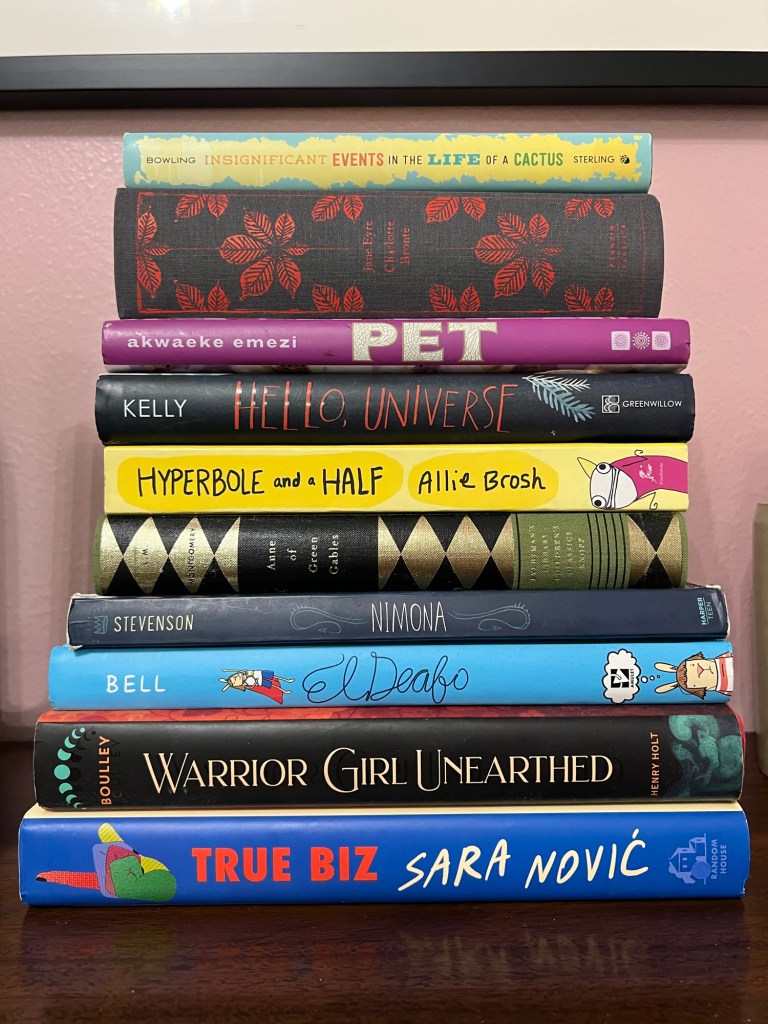
Which is perhaps why this book stack is such a mixed bag: I am impressed by every disabled author who bares their soul putting their own experiences on the page. But sometimes, living the reality all day and living it again during your “fun” time is…not fun. The ones like Cece Bell and Allie Brosh, who dig in with humor, become repeat reads on my shelf. Incidental disability, nestled into a larger story, also tends to find space on my shelf. Stories where disability is the story are most often borrowed from the library.
A few years ago, in an attempt to read more books by disabled authors, I tried Give me a Sign by Anna Sortino. The hearing test and hearing aid recalibration scene in the first ten pages gave me an anxiety attack. Don’t get me wrong, Sortino does a good job of portraying the annoyingly mundane details of hearing loss (there is only so much space behind your ears) and its ability to amplify the stakes of all social situations. Her MC fell for a nice guy, so there was only so much shade I could throw as she fretted DOES HE LIKE MEEE??? Those “casual hangouts” where you spend the entire time vibrating with anxiety because you don’t have all the channels you need to process the context, and consequently can’t read social cues, are still fresh in my memory. Reading those scenes was another anxiety attack. Guess I haven’t processed that trauma yet, whoops.
I am so appreciative when non-disabled authors put in the real work to incidentally convey a disabled identity well: it is hard work and I am so grateful they chose to do that work. Shoutout to Angeline Boulley, local author Dusti Bowling and our perennial favorite, Erin Entrada Kelly.
The classic titles…neither Charlotte Brontë nor L. M. Montgomery rose above their time when it came to portraying not-English or not Scots-English Canadian characters with sensitivity and nuance. We know where they failed. But reading these titles when I was younger offered some of those “it’s not just me” moments that helped me build a bridge to something better.
Enter Pet. This title featured on my Queer reads rainbow, and I will pull it out again for having hands down the best, most spare, and accurate representation of a neurodivergent meltdown I have ever read. I hope to keep finding more titles like these, written with beauty, humor, and more grace than we often give ourselves.
Titles
Insignificant Events in the Life of a Cactus, by Dusti Bowling
Jane Eyre, by Charlotte Brontë
Pet, by Akwaeke Emezi
Hello, Universe, by Erin Entrada Kelly
Hyperbole and a Half, by Allie Brosh
Anne of Green Gables, by L. M. Montgomery
Nimona, by N. D. Stevenson
El Deafo, by Cece Bell
Warrior Girl Unearthed, by Angeline Boulley
True Biz, by Sara Novic
[Image description: stack of books with disabled and neurodivergent or neurodivergent-coded characters on a dark wood side cabinet]

